
Development of lymphocytes:
All adult circulating blood cells, including immature lymphocytes, are produced in the bone marrow. Bone marrow is also the site of maturation of B cells. Cells of the immune system are produced by a group of undifferentiated cells, called hematopoietic stem cell (HSC) in bone marrow. A hematopoietic stem cell may be multipotent or pluripotent, that can undergo mitosis to form more such cells and are able to differentiate in various ways. Blood cell production is termed hemopoiesis. All immune system cells derive from a bone marrow hematopoietic stem cell, which produces two main lineages: a myeloid progenitor cell and a lymphoid progenitor cell.
Hematopoiesis starts in the blood islands of the yolk sac and the para-aortic mesenchyme, then moves on to the liver and spleen. Eventually, the bone marrow and the marrow of the flat bones take over this function, and by puberty, hematopoiesis is primarily found in the sternum, vertebrae, iliac bones, and ribs. As they mature, all lymphocytes express antigen receptors and take on the phenotypic and functional traits of mature cells. T lymphocytes develop in the thymus, while B lymphocytes reach full maturity in the bone marrow. Once the cells reach maturity, they exit the thymus or bone marrow, enter the bloodstream, and settle in the peripheral lymphoid organs. We refer to these developed cells as naïve lymphocytes.
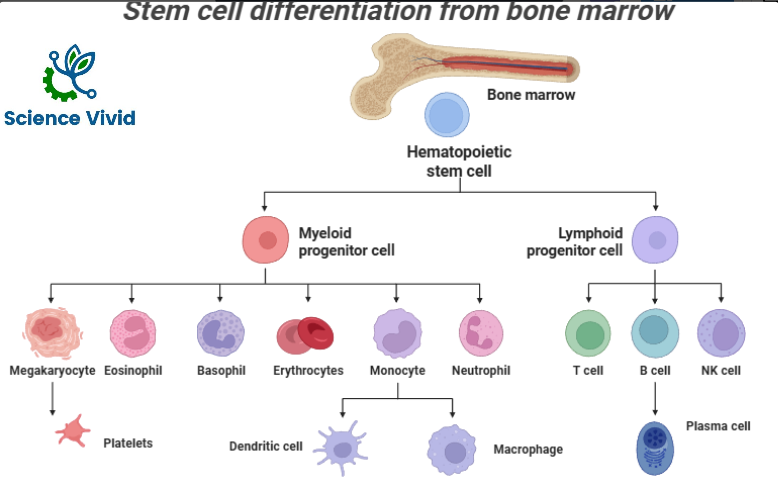
Fig: Production of lymphocytes in bone marrow
Activation of Lymphocytes:
Antigens and other stimuli cause naive lymphocytes to develop into effector and memory cells during adaptive immune responses. After stimulation, lymphocytes start to produce a range of novel proteins and transcribe previously quiet genes. These proteins include cytokine receptors, which increase lymphocyte sensitivity to cytokines, secreted cytokines in T cells, which promote the growth and differentiation of lymphocytes and other effector cells, and numerous other proteins involved in gene transcription and cell division. The antigen-specific lymphocytes divide mitotically in response to antigen and growth factors produced by the antigen-stimulated lymphocytes and other cells. This causes the antigen-specific clone to proliferate and grow larger—a process known as clonal expansion. A portion of the antigen-stimulated lymphocytes develop into effector cells, which are responsible for eradicating the antigen. Helper T cells, Cytotoxic T Lymphocytes (CTLs), and B cells that secrete antibodies are examples of effector lymphocytes. Differentiated helper T cells release cytokines that stimulate other cells and display surface proteins that interact with ligands on other cells, including macrophages and B lymphocytes. Granules carrying proteins that destroy tumor and virus-infected cells are produced by differentiated CTLs.
B lymphocytes undergo differentiation into cells that actively produce and secrete antibodies. Some of these cells that produce antibodies can be recognized as plasma cells. After developing in lymphoid organs and immune response sites, plasma cells frequently migrate to the bone marrow, where some of them may persist for extended periods of time even after the antigen has been eradicated and the immune response has been triggered. Some of the progeny of antigen-stimulated B and T lymphocytes differentiate into memory cells, which serve to mediate quick and enhanced (i.e., secondary or recall) responses to second and subsequent exposures to antigens. Most differentiated effector lymphocytes are short-lived and do not self-renew. After the antigen is removed, memory cells may continue to exist for many years in a condition of sluggish cycling or functional quiescence.
Antigen-Presenting Cells (APCs): Types and Functions:
Cell populations known as antigen-presenting cells (APCs) are specialized in capturing microbial and other antigens, presenting them to lymphocytes, by loading on an appropriate Major Histocompatibility Class (MHC) and sending signals that promote lymphocyte proliferation and differentiation.
Dendritic cells (DCs)
Dendritic cells are the professional APCs when it comes to capturing antigens and stimulating T lymphocyte responses to protein antigens. Most organs contain dendritic cells beneath the epithelia, which are ready to absorb foreign antigens and carry them to peripheral lymphoid organs.
Mononuclear phagocytes (Macrophages)
In T cell-mediated adaptive immunological responses, mononuclear phagocytes serve as APCs. Microbial antigens are presented to differentiated effector T lymphocytes by macrophages that have consumed microorganisms. The macrophages are then triggered by the effector T cells to eradicate microorganisms. One important method of cell-mediated immunity against intracellular microorganisms is this process.
Immune Cells and Their Roles:
Natural Killer Cells (NK cells)
Natural killer cells have more cytoplasm and noticeable granules and thus, are referred to as big granular lymphocytes. They are a part of the innate immune system. NK cells lack the adaptive characteristic of memory cell growth and do not express antigen-specific receptors. Their primary job is to kill tumor and contaminated cells by causing their targets to undergo apoptosis. They eliminate cells that have decreased MHC class I molecule expression, which can be brought about by viral infection or malignant transformation. NK cells also have Fc receptors for IgG; this phenomenon, known as antibody dependent cellular cytotoxicity (ADCC), can be caused by contact with antibodies that are selectively attached to antigens on a target cell surface. Interferon A (made by virally infected cells) activates NK cells.
Neutrophils (Polymorphonuclear Neutrophils)Basophils
Neutrophils are non-dividing short-lived cell with a multilobed nucleus and an array of granules. They are unstained by histologic dyes such as hematoxylin and eosin.
Basophil
Basophils are the least frequent form of granulocytes in the immune system that are essential for triggering allergic reactions and inflammatory and battling against parasites.
Eosinophil
Eosinophils are the granulocytes essential to the immune system involved in parasitic infections and allergic reactions. They include granules that, when hyperactive, release toxic and inflammatory proteins that are essential for defense but can also cause tissue damage and inflammation.