
Basis of Classification of Animals:
Level of body organization
- Cellular grade: Porifera
- Tissue grade: Coelenterata
- Organ grade: Platyhelminthes
- Organ system grade: Nemathelminthes, Annelida, Arthropoda, Mollusca, Echinodermata, Chordata
Body symmetry
- Asymmetry: Most poriferans, Gastropods
- Radial symmetry: Coelenterata, Echinodermata
- Bilateral symmetry: Platyhelminthes to Chordata except
- Echinodermata
Germ layers
Diploblastic: Porifera and Coelenterata
Triploblastic: Platyhelminthes to Chordata
Body plan
- Cell aggregate: Porifera
- Blind sac: Coelenterata and Platyhelminthes
- Tube within a tube: Nemathelminthes to Chordata
- (Protostomes or deuterostomes)
Coelom
- Acoelomate: Porifera, coelenterate and platyhelminthes
- Pseudocoelomate: Aschelminthes
- Eucoelomate: Annelida to Chordata
- Schizocoeleom: Annelida except leech (hemocoelom)
- Hemocoelom: Leech, Arthropoda, Mollusca (except Cephalopoda)
- Enterocoelom: Echinodermata to Chordata
Body segmentation
- Metameric segmentation: Annelida, Arthropoda (Tagmatization)
- Pseudometamerism: Cestodes
- No segmentation
Introduction to Helminthes and Helminthology:
Helminthology is the study of helminthes, which are animals that resemble worms. Helminthes are metazoans with well-developed organs, vermiform bodies. It comprises of phylum Platyhelminthes and Nemathelminthes.
Phylum Platyhelminthes:
General characteristics
- Symmetry: Bilaterally symmetrical
- Organ level grade of body organization
- Body plan: Incomplete, ingests and egests by mouth
- Germ layers: It is triploblastic.
- Coelom: Acoelomate
- There is the process of cephalization
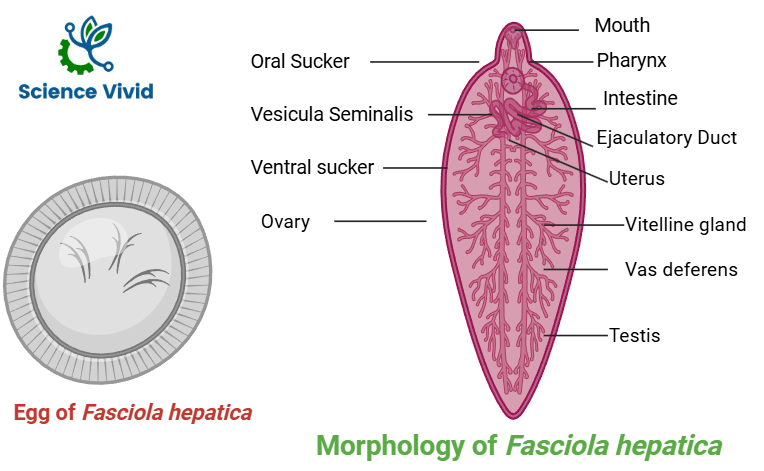
Fig: Morphology-and-egg-of-Fasciola-hepatica
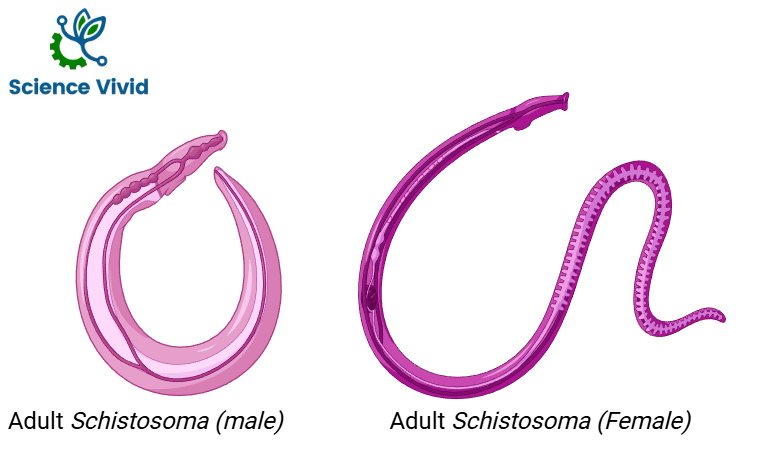
Fig: AdultSchistosoma (Male and Female)
Habit and habitat
- Both aquatic and terrestrial
- Exclusively endoparasite class is Cestoda
- Turbellaria: Land Bipalium (Hammerhead worm), marine water, (Convoluta), freshwater Planaria (Dugesia)
- Trematoda (Ectoparasite: Fish fluke (Gyrodactylus, Dactylogyrus), Endoparasite: Tapeworm (Taenia spp)
Body Wall and Organ Systems
- Tegument: Contains thick cuticle in parasitic forms
- Epidermis: syncytial and ciliated (free living)
- Musculature: longitudinal, circular and oblique
Excretion, Digestion, Respiration
- Excretion by solenocytes or flame cells.
- Ammonotelic, also excretes fatty acids and carbon dioxide
- Digestion: Digestion is extracellular. Digestion is absent in cestodes
- Skeleton and circulation system absent
- Respiration: Via general body surface (anaerobic in endoparasites)
Classification of Platyhelminthes:
Class 1- Turbellaria
- Commonly called eddyworms
- No hook, no sucker
- Rhabdites present for protection
- They possess well-developed sensory structures, including chemoreceptors and photoreceptors, with a pair of light-detecting ocelli (eyespots).
- These organisms exhibit an exceptionally high capacity for regeneration, allowing them to restore lost body parts with remarkable efficiency.
Class 2- Trematoda
- Often referred to as flukes
- Suckers (anterior and ventral) are present for attachment and feeding.
Class 3 – Cestoda
- Commonly known as tapeworms
- They completely lack a mouth and digestive tract; instead, the anterior region, known as the scolex, is equipped with attachment structures such as hooks and suckers to anchor the worm to its host.
- Fertilization: self-fertilization is possible but not protandrous.
- Strobilation (formation of new strobili) and apolysis (breakdown of gravid segments)
Comparison of Turbellaria, Trematoda, and Cestoda:
| Characteristics | Turbellaria | Trematoda | Cestoda |
| Shape | Leaf-like | Leaf-like | Tape of ribbon like |
| Mode of life Presence of cilia | Free-living Yes | Ecto- and endoparsties No | Exclusively endoparasite No |
| Development | Direct | Direct (ectoparasite) or indirect (endoparasite) | Indirect |
| Presence of alimentary canal | Yes | Yes | No |
| Present of adhesives | No | Suckers | Rostellum, sucker, hooks |
| Head | Cephalic lobe | Cephalic lobe | Scolex |
| Examples | land Bipalium (Hammer-head ttapeworm), marine water Convulata, freshwater Planaria (Dugesia) | Ectoparasites: Fish fluke (Gyrodactylus, Dactylogyrus), Endoparasite: Liver fluke (Fasciola hepatica), Blood or lymphatic fluke (Schistosoma), Lung fluke (Paragonimus westermani) | Tapeworm (Taenia solium: Pork tapeworm, Taenia saginata: Beef tapeworm), Dog tapeworm: Echinococcus granulosus, Hymenolepis nana (Dwarf tapeworm, Hydatid worm), Diphyllobothrium latum (Broad fish tapeworm) |
Phylum Nemathelminthes (Aschelminthes):
General Characteristics
- Symmetry: Bilaterally symmetrical
- Organ-system level of body organization.
- Germ layers: Triploblastic
- Body plan: Complete with mouth forming first
- Coelom: Pseudocoelom (i.e pseudocoelomate or blastocoelomate)
- No distinct head
- Body unsegmented
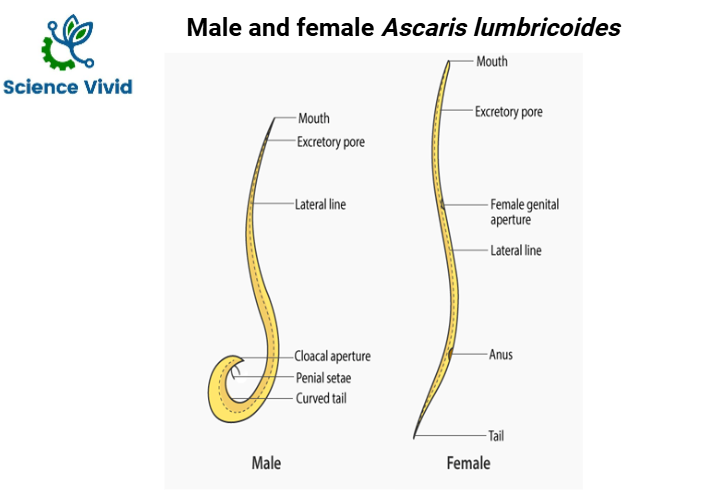
Fig: Male and female Ascaris lumbricoides
Body Wall and Organ Systems
- Both respiratory and circulatory system are absent.
- Excretory by renette cells
- Reproductive system
- All are dioecious i.e.; sexes are separate with sexual dimorphism. [1st unisexual phylum]
- Fertilization internal
- Larval forms: Rhabditiform, Filariform, Microfilariae etc.
- Body layers
- Cuticle: non-living, undergo moulting
- Epidermis: syncitial, secretes cuticle bears scleroprotein, secretes antienzyme
- Muscularis: longitudinal muscle fibre
Medically Important Nematodes:
| Nematode | Habitat in host | Parasite life cycle | Primary host | Secondary host |
| Ascaris lumbricoides (Roundworm) | Small intestine especially jejunum | Monogenetic | Man | |
| Ancylostoma duodenale Necator americanus (Hookworm) | Small intestine especially jejunum | Monogenetic | Man | |
| Wuchereria bancrofti (Filarial worm) | Lymphatic system | Digenetic | Man | Culex mosquito |
| Enterobius vermicularis (Pinworm or seatworm) | Large intestine | Monogenetic | Man | |
| Trichuris trichiura (Whipworm) | Large intestine | Monogenetic | Man | |
| Dracunculus medinensis (Guinea worm) | Deeper tissue of skin | Digenetic | Man | Cyclops |
Classification: based on sensory papillae:
| Class | Aphasmida (Adenophorea) | Phasmida (Secernentae) |
| Phasmid present | absent | Phasmid present |
| Mode of life | Free living | Parasitic |
| Example | Desmoscolex (water), Rhabditis (Land) | Ascaris lumbricoides (Roundworm) Ancylostoma duodenale Necator americanus (Hookworm) Wuchereria bancrofti (Filarial worm) Enterobius vermicularis (Pinworm or seatworm) Trichuris trichiura (Whipworm) Dracunculus medinensis (Guinea worm) Loa loa (Eye worm) |